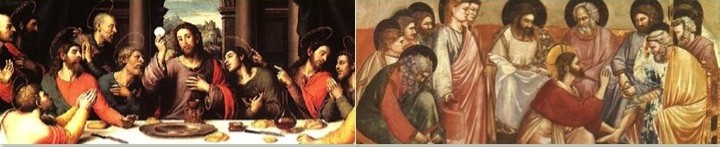
“The Word became flesh.” (John 1:14)
“Jesus Christ is true God and true man, in the unity of His divine person” (CCC 480)
Writing about theology is often a process of recapitulating in a few minutes or hours what the Church has struggled with and elucidated over two thousand years. This is both a blessing and curse. A blessing, of course, because now in the 21st century, we have the luxury of these neatly and elaborately defined dogmas; and a curse, because it’s not always an easy task sifting through the minutiae of two millennia of history and exegesis. These religious ideas and doctrines we take for granted now have been struggled with, debated, fought over, scandalized, held Councils about, and in the cases of the various heresies, called heretical and anathema, but all the while leading to more refined doctrines and creeds of the Church. Such is the will of God, that we should “love the Lord, your God, with all your heart, with all your soul, and with all your mind.” (Mt. 22:37-38) Jesus instructed us, by adding to the Deuteronomic quote (Dt.6:5), that we should love God with “all your mind.” And hence, the Church, and the doctors of the Church, theologians and saints have studied the Word of God, the Bible, the teachings of the Apostles, the Traditions of the Church, and life of Jesus, parsing every word and deed to understand the true nature of God. This dialectic struggle within the Church over the two thousand years has resulted in 21 major ecumenical Church Councils, in order to resolve the nearly as many major heretical movements within each century. Loving God with all your mind is easy, but precise exegetical, Church-approved analysis has been long, hard, and arduous. In no area has this been more contentious than Christology, or the study of the nature and person of Jesus Christ.
The “Hypostatic Union” is the theological term positing the fusion of the divine and the human in the person of Jesus Christ. Hypostasis (ὑπόστασις) is the Greek word referring to the “underlying substance” of something, or “concrete existence” of a person. In Christian theology, it refers to the union of the two natures of Christ in the one divine person. Christ had two natures, one human and one divine; as well as two intellects and wills, or “modes of operation,” one human and one divine. Taken together, the two natures and the two intellects, and wills or operations, they form in perfect union the one divine man, Jesus Christ. It seems so straight-forward to us now. What was so difficult? I jest, yet this simple phrase had a long, struggled history. The struggle began back with the first ecumenical Council at Nicea in 325 AD. This Council was called to deal with a heresy involving a popular priest named Arius. Arius believed that Jesus was not consubstantial with God the Father, but was rather “homo-i-ousios,” or of “like or similar substance and being,” in effect, Jesus was less than the Father. A huge schism was created in the Church between those who believed in homo-i-ousios and those who adhered to “homo-ousios,” or that Jesus and God the Father were “of one substance or being.” As Edward Gibbon had noted the world was divided over “one iota.” Thus, the Council met and then issued the Nicean Creed. This declared Jesus “homo-ousios,” or “consubstantial” with God the Father, the same creed we repeat in mass to this very day.
After that, the Christological struggle to define the exact nature of who Jesus is continued on for centuries. In the fifth century, the Patriarch of Constantinople, Nestorius, had felt uncomfortable calling Mary “Theotokos,” (in Greek Θεοτοκος) or “God-bearer,” since he did not think she was the cause of Jesus’ divinity. As such, he ended up devising a doctrine, Nestorianism, that essentially divided Jesus into two persons, one divine (Logos) and one human (son of Mary). This, of course, in response led to the Council of Ephesus in 431 AD. The Council proclaimed Mary is not the cause of Jesus’ divinity since He’s consubstantial with the Father for all eternity. As well, it proclaimed Mary is not the cause of Jesus’ human soul since that is also from God. Yet, the Council reaffirmed the hypostatic union of a divine nature and a human nature in the one divine person of Jesus Christ. Being that Mary bore the divine person, Jesus, and not just His human nature, it is in fact true to call her the bearer of God.
A couple of decades later a Byzantine monk, Eutyches, had began advocating that there was really only one nature in Christ; or that His human nature was absorbed by His divine nature. This heresy was termed “Monophysitism,” or that Christ only had a divine nature. In 451 AD, the Church called the Council of Chalcedon to deal with this. The Council declared Jesus had “two natures, without confusion, without change, without division, without separation.” They reaffirmed that Jesus was one person and one hypostasis with two natures, one human and one divine. In the 7th century, the Monothelitism heresy posited that Christ only had one will and one natural operation; eliminating the distinctly human will in Christ, in favor of His divine will. In response to this, the Church called the Third Council of Constantinople in 681 AD. The Council eventually declared, in reiteration of the Chalcedon declaration, that Christ possessed “two natural wills and two natural energies, without division, alteration, separation or confusion.” (III Council of Constantinople) The Hypostatic Union had finally triumphed! Jesus Christ, the God-man, is one divine person, of one substance with the Father, with two natures, human and divine; two wills, human and divine; and two modes of operation, human and divine.
Yes, there are two natures and two wills in Christ, yet they always act in harmony together. Jesus was perfectly one with Himself, undivided. He is the perfect model for us to align our human nature and our human will with the divine nature and the divine will. In us, our nature and our will resist the divine nature and the divine will. In Christ, His human nature and His human will were in perfect obedience and submission to the divine. We, because of Original Sin, are divided; He, without sin, is one. The Catechism quotes the Council of Constantinople III in this respect saying: Christ’s human will “does not resist or oppose but rather submits to His divine and almighty will.” (CCC 475) As the Church Fathers teach us, the obedience of Christ atoned for the disobedience of Adam. Only Christ could have done this. Jesus is in a sense properly defined as “theandric.” Theandric taken from the root Greek words, “theos,” (θεός) meaning “god;” and “andros,” (ἀνδρός) meaning “man.” Christ properly understood is both God and man united as one person, or literally, the God-man. In the 7th century St.John of Damascus wrote, “Thus, the theandric operation shows this: when God became man, that is to say, was incarnate, His human operation was divine, that is to say, deified. And it was not excluded from His divine operation, nor was His divine operation excluded from His human operation. On the contrary, each is found in the other.” The divine operation and the human operation are independent and separate, yet they subsist – one in the other – in Jesus Christ. St.Thomas Aquinas in the Middle Ages wrote, “Dionysius* places in Christ a theandric, i.e. a God-manlike or Divino-human, operation not by any confusion of the operations or powers of both natures, but inasmuch as His Divine operation employs the human, and His human operation shares in the power of the Divine.” (Aquinas) Thus, what Aquinas argues is that because of the dual nature of Christ as both human and divine, it appears as though He operates with a single, theandric operation. Yet, what is really happening is the two distinct natures of Christ are operating in perfect communion with each other, so much so as to appear as a single, theandric operation.
“Everything that Christ is and does in this nature derives from ‘one of the Trinity.’ The Son of God therefore communicates to His humanity His own personal mode of existence in the Trinity. In His soul as in His body, Christ thus expresses humanly the divine ways of the Trinity.” (CCC 470) The Catechism shows that, although separate, the divine is part of His human nature and the human is part of His divine nature. Christ’s humanity was a deified humanity. As in the healing of the leper, Christ uses the divine operation to heal, but He also uses His humanly operation to touch. In the raising of Lazarus, He uses His divine operation to resurrect, and His human operation to speak it. In these instances, as in all the others in His life, the divine operation is made manifest in perfect harmony with the human operation. And the human operation acts in perfect obedience to the divine operation. In the epistle to the Hebrews, St.Paul calls Christ, “the exact imprint of God’s very being.” (Heb.1:3)** That is, Christ is God made manifest in the flesh. The life of Christ is the human biography of the Trinity. Since the human and divine, though distinct, work in perfect operation together in Christ, His operations are, in effect, theandric. Each of His humanly actions are in conjunction with Godly actions. It can be surmised then that each of His actions is of infinite merit and grace. For the divine is operating within the natural. The Catechism says, “Christ’s whole life is a mystery of redemption.” (CCC517) The smallest of His actions take on divine efficaciousness. There are no small actions in the life of the God-man. Because of this, Aquinas can say, “Consequently, Christ did merit in the first instant of His conception.” Then, all of Christ’s actions throughout His life are of divine worth imbued with supernatural grace. Hence, when Christ reaches the climax of His life with His Passion and Crucifixion, His death takes on infinite value, capable of saving all of humanity from sin, and even death itself. The infinite dignity of God, offended by the sin of man, is now satisfied by the infinite sacrifice of Christ, the God-man.
*Dionysius refers to the fifth century monk Gaius, a theologian who operated under the name Pseudo-Dionysius the Areopagite. He was one of the first to refer to Christ’s actions as “theandric.” He said, “by virtue of being God-made-man He accomplished something new in our midst – the activity of the God-man (ie, the theandric activity).” The error in his thought is by proscribing in Christ “one” mode of operation, not two.
**This line includes the use of the Greek word “hypostasis.”